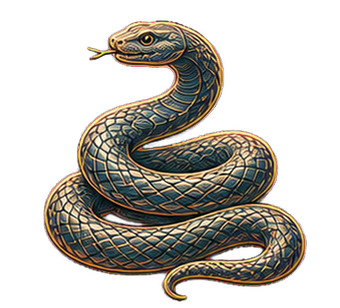
A snake in a dream does not speak with a single voice. In the books consulted here, the same image can map to an enemy or to great wealth, to a personal betrayal or to the cycle of renewal. Context — where the snake appeared, what it did, and how you felt — is what narrows the field.
Below, three distinct traditions are laid side by side. They do not always agree, and that divergence is the point. The material comes from the general English dream book of Gustavus Miller (1901), the classical Arabic dream manual of al-Nabulsi (Damascus, 1731), and a Yoruba understanding of Oshumare, the rainbow serpent.
What the snake makes visible
A dead snake biting a woman (Miller)
Miller reads this narrowly: it points to suffering from the malice of a pretended friend. The danger is not an open fight but something that wears the face of friendship. The deadness of the snake does not cancel the bite — some harm outlasts its source.
Possessing a large serpent (al-Nabulsi)
Al-Nabulsi treats a large serpent as a sign of enmity from close quarters — family, a spouse, children, or an envious neighbour. But to possess such a serpent, to hold it as yours, flips the reading: it foretells gaining great authority. The same image can signal danger or power, depending on who is holding whom.
The snake as enemy (al-Nabulsi)
Across al-Nabulsi’s entries, a snake is frequently a wealthy enemy — wealth, because its poison is read as money. Bringing a snake into your house warns that an enemy is plotting against you. Catching it, by contrast, means you will safely obtain an enemy’s property. When the ruler is the one hunting snakes, the destruction of enemies is implied.
Oshumare, the rainbow serpent (Yoruba perspective)
Where Miller and al-Nabulsi see a figure of opposition — a pretended friend, a hostile neighbour — this reading offers a different shape. Oshumare is the rainbow, the serpent of cycle and renewal. What ends does not end for good: a skin is shed, and the same thing returns on a new turn. A snake here is not an enemy but a sign that a closed door may later open.
When the sources look at the same serpent and see different things
Miller and al-Nabulsi both read the snake as a kind of threat — malice, an enemy, an evil neighbour — but the grammar of that threat shifts. Miller places the bite inside a friendship; al-Nabulsi locates it in the household or inside wealth itself. And then the Yoruba understanding of Oshumare meets the same image and refuses the idea of a purely hostile snake. Here the serpent is the arc that curves back, the promise that a loss is not absolute. One tradition’s warning is another’s reassurance. The books are not broken because they diverge; they simply notice different parts of the creature.
A snake in a market killed, a flying snake departing, a water serpent beside a judge — each of these small details redirects the reading in al-Nabulsi’s manual. Miller’s wriggling mass of snakes points to struggles with fortune and remorse, while his image of killing a snake says you have pushed your own interests forward. The dreamer’s feeling in the dream — terror, calm, the sense of something sacred — is what tells you which page to open.
Want a reading through a specific lens?
The bot can read a snake dream through each of these traditions — Miller, al-Nabulsi, or the Yoruba understanding — and still others. You choose which in its settings.
Read your dream