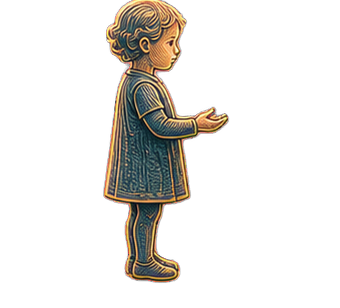
A dream of children draws on the oldest human hopes and fears. One book sees a promise of prosperity dropping into your hands; another weighs the child's form and circumstance like a scale; a third tradition reminds you that what comes in pairs is never the work of a single mind. Each reading stands on its own ground — none cancels the others.
The material below is drawn from three separate sources: the general English dream manual of Miller (1901), the classical Arabic work of Imam al-Nabulsi (Damascus, 1731), and a Yoruba understanding centred on Ibeji, the paired and the childlike. Where the books disagree they are not broken; they are simply different instruments tuned to different ears. Context and your own feeling inside the dream always steer the meaning.
How the Books Read the Child
Beautiful Children (Miller)
Miller gives this image the weight of a broad promise. Dreaming of many beautiful children signals great prosperity and blessings arriving. Sweet and fair children, in his verse, bring a suave, debonair fortune — wealth and happiness robed in shining dress. For a mother who dreams her child is sick from a slight cause, the book offers a specific reversal: the child may enjoy robust health, though small troubles of another kind might still harass her waking mind.
The Infant Boy and the Adolescent Boy (al-Nabulsi)
Al-Nabulsi distinguishes sharply by age. A small carried infant boy indicates worry and grief. An adolescent boy brings good tidings — if a city is besieged and a beautiful boy descends from heaven or emerges from the earth, relief is near. A grown boy signals might and strength. Seeing yourself as a boy learning in Qur'anic school points to repentance from a sin, while a scholar or governor who sees himself in that school is warned of becoming ignorant or faltering in his station.
Pregnancy Seen or Experienced (al-Nabulsi)
A woman dreaming of her own pregnancy receives a reading of steadfastness in her affairs, gaining wealth, increase, pride, might, and good repute. A man who sees himself pregnant carries a heavy, hidden worry, though the dream may still indicate an increase in worldly goods for the dreamer, male or female. Seeing a pregnant woman in a dream points to worry, vexation, and hidden matters that press on the waking mind.
The Male Child and Dependents (al-Nabulsi)
Because God has preferred the male over the female, al-Nabulsi reads the male child generally as an indicator of excellence and abundance. Seeing one's dependents in a dream points to wealth for the dreamer, a reading the book anchors in the Quranic promise of enrichment. An aqiqa sacrifice performed lawfully in a dream — slaughtering what is proper — shows good conduct in worldly and religious affairs, and may carry good tidings of an absent person's return, a sick person's recovery, or a prisoner's release.
Ibeji: The Paired and the Childlike (Yoruba tradition)
In a Yoruba reading, the child image calls forward Ibeji — twins, children, joy, and things that come in pairs. The emphasis falls on what is childlike and what is doubled. This is a symbol that must not be decided too gravely, nor alone. The dream points to shared delight, to what arrives in twos, and to a lightness of spirit that is not carelessness but a recognition that some blessings only work when they are held in common.
A Forked Road, Each Branch True
Look at the difference honestly. Miller hands you fortune dressed in light; al-Nabulsi hands you a scale where a carried infant weighs grief and an adolescent boy weighs relief. One source rarely mentions the dreamer's own condition; the other ties nearly every reading to whether the land is besieged or the heart is repentant. Neither source is diluted, and neither is made to apologise. The point is not to reconcile them but to see that a child in sleep can be a mirror angled differently by each tradition. Your own circumstances tell you which surface is catching the light.
A Yoruba elder might add that Ibeji does not ask for a heavy verdict at all. Where Miller predicts and al-Nabulsi weighs, the paired child simply invites — to a joy you cannot hoard, a meaning you cannot finalise by yourself. All three books are in the room. You are the one still dreaming.
Which Book Should Read Your Dream?
The same dream can sound entirely different when Miller, al-Nabulsi, or a Yoruba understanding holds the lamp. This dictionary can read any dream through the tradition you choose — simply set your preference in the bot settings and tell it the dream.
Choose a Tradition