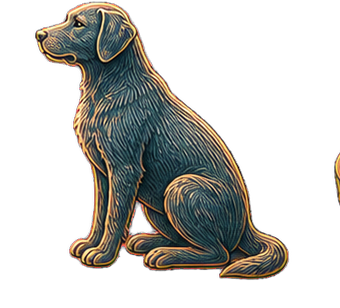
One dream image can carry completely different weights. In English dream books a dog often speaks of friendship, gain or a lurking enemy. In the classical Arabic manual of al‑Nabulsi, the animal is read first as a person’s moral character — a sinner, a fool, or a quarrelsome temperament. Meanwhile within the Yoruba tradition, a dog may appear as an instrument of Èṣù, the divine messenger and trickster who opens roads or sets tests. None of these traditions cancels the others; they simply offer the dreamer different maps for the same territory.
The pages that follow lay out what the sources actually say, without choosing one as correct. Context and the feeling inside the dream matter enormously — a dog that terrifies you and a dog that sits quietly at your feet belong to different stories.
The image, unpacked
Miller’s reading (English, 1901): A friendly dog
When a dog fondles you, Miller promises great gain and constant friends. Owning a dog with fine qualities is linked to solid wealth. Even a lap‑dog, if healthy, foretells being helped by friends in an approaching dilemma. The positive side of the dog in this tradition is unmistakably about loyalty, protection and material prosperity.
Miller’s reading (English, 1901): A vicious or blood‑hound dog
A vicious dog points to enemies and unalterable misfortune. If a blood‑hound tracks you, the danger is a temptation that could cause a downfall. A mad dog signals scurrilous attacks from enemies; killing it flips the meaning and promises victory over adverse opinions and strong financial success.
Al‑Nabulsi’s reading (Arabic, 1731): The dog as a person
In al‑Nabulsi’s book the dog is a foolhardy sinner. A barking dog is an insolent, vile‑tempered man. A bite or scratch means harm from an enemy matching the degree of pain felt, possibly illness. If the dog tears your clothes, a fool gossips about you. Silence — no bark heard — carries a milder note: an enemy abandons enmity for a trifle. A bitch is read as a low woman from an evil, stubborn people. A white puppy represents a beloved believing child; a black puppy rules his household; some say a foundling raised by someone.
A Yoruba glimpse: The dog and Èṣù
Within the tradition of Èṣù, the divine messenger and trickster, the dog is one of the creatures closely associated with his work. Èṣù opens and closes paths, tests human character, and delivers sacrifices. A dog in a dream may therefore be read as a sign that Èṣù is near — bringing a test, a message, or a choice. Much depends on the dog’s behaviour and the dreamer’s own situation. This is not a universal Nigerian belief, but a distinct reading inside a specific tradition.
One image, three maps
A dream of a dog cannot be reduced to a single omen. In Miller’s world the animal is often a mirror of friendship and financial fortune, or a warning about a human enemy. Al‑Nabulsi treats the dog almost entirely as a portrait of moral character — the barking fool, the biting enemy, the low woman. The Yoruba reading shifts the lens again, placing the dog in the domain of a trickster‑messenger whose business is not good or evil but movement, choice and consequence.
The real task belongs to the dreamer. Did the dog nuzzle your hand or snap at your heels? Did it bark, stay silent, or disappear? Your own feeling upon waking is as much a part of the meaning as any line in any book.
Read your dream through the tradition that speaks to you
This bot can unpack a dream through Miller, al‑Nabulsi, or a Yoruba frame — you choose which in your settings. No single tradition is forced on you; the reading follows the book you pick.
Interpret a dream now